
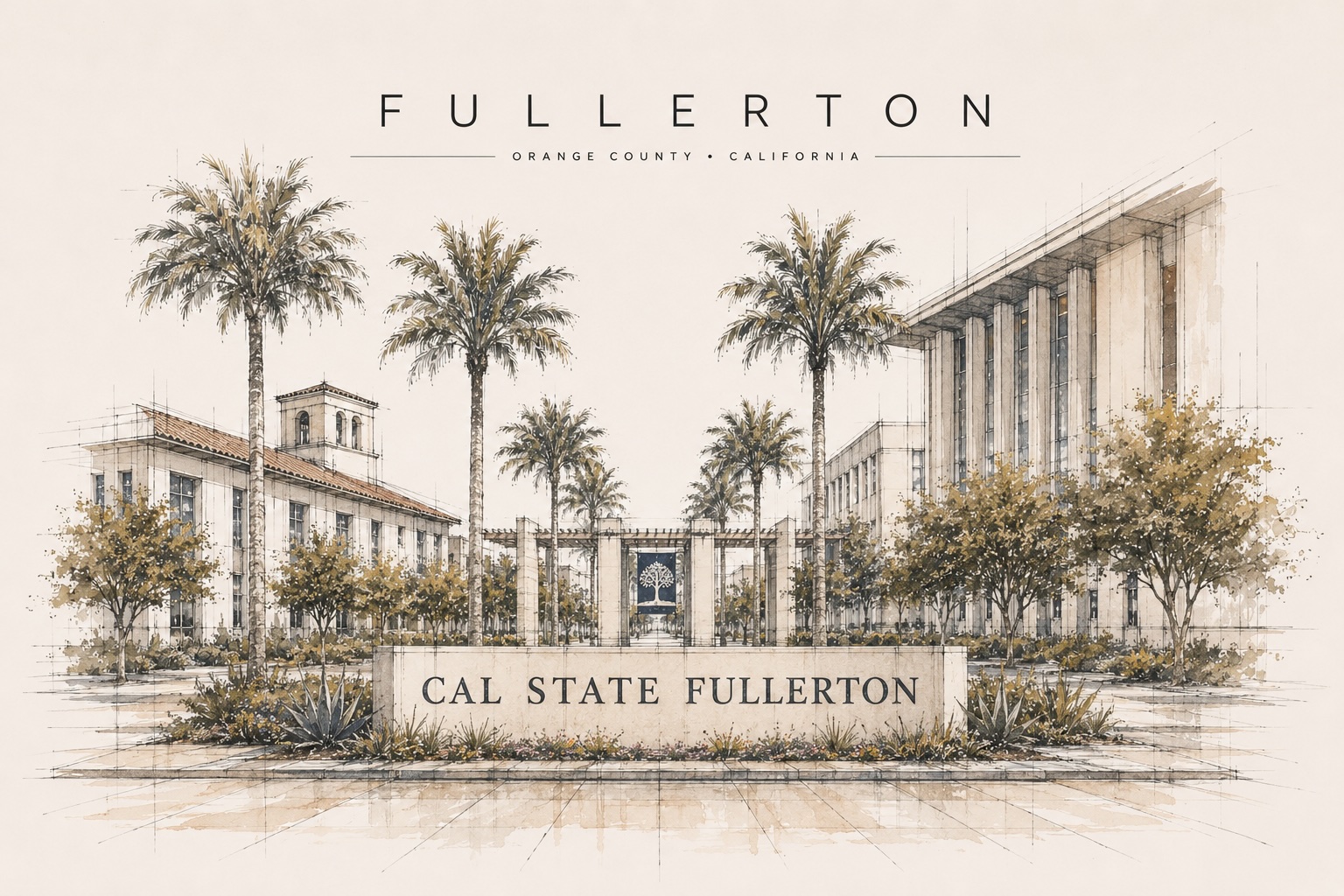
Fullerton
College town character, historic downtown, North OC access
At a Glance
Fullerton is a college town anchored by California State University, Fullerton. The historic downtown is walkable, with local restaurants, shops, bars, and music venues. The city has character and community in a way many planned OC suburbs do not. It is generally more attainable than coastal cities while remaining connected to Orange County and LA via freeway and rail.
This is a place where you can actually walk to get coffee, a meal, a drink, or a cultural event in the right pocket. The student population keeps things young and energetic. The downtown has real history, older architecture, and independent businesses. It is one of the clearest college-town experiences in Orange County.
The Big Picture
Fullerton was founded in 1887 and developed as a regional commercial and agricultural center. The downtown area retains historical character with older architecture, mature trees, and walkable blocks. California State University, Fullerton was established in 1957 and began classes in 1959, and it helped shape the city into a college town.
Downtown revitalization, Metrolink access, and proximity to LA have made Fullerton attractive to people seeking walkability without living in coastal OC or Los Angeles proper.
The Highlights
Downtown Fullerton is walkable and historically grounded: Commonwealth Avenue has local restaurants, bars, music venues, and independent businesses in older architecture that predates the postwar suburban wave. California State University, Fullerton, established in 1957, adds consistent cultural programming, performances, and a younger energy that extends beyond campus. The Fullerton train station, served by Metrolink and Amtrak (including the Pacific Surfliner), provides rail access toward downtown LA and regional stops without needing a car for those trips. Neighborhoods near campus and downtown have real pedestrian life; outer residential pockets are quieter and more car-dependent. Pricing is generally more moderate than coastal OC markets, though it varies meaningfully by pocket and property type.
Lifestyle
Daily life is structured around downtown if you live close enough to it. You can walk to coffee shops, restaurants, bars, galleries, and music venues. Commonwealth Avenue has real pedestrian life. The college environment brings performances, arts events, and younger energy.
CSUF adds cultural programming and activity. The rail station provides car-free access toward downtown LA and other regional stops. Beaches are reachable for weekend trips, and the city has a useful park network.
Housing
Fullerton pricing is generally moderate by OC standards, but it varies meaningfully by pocket. Older character homes near downtown, suburban neighborhoods farther out, apartments near campus, and hillside or larger-lot properties should not be treated as one market. Rentals are significant because of the college presence, and competition can vary by neighborhood. Verify current pricing, rental data, property condition, and school assignment with a licensed agent for any specific budget.
The Tradeoffs
The college presence creates upsides and downsides: energy, events, and walkability on one side; noise, parking pressure, and turnover on the other. Some neighborhoods near campus or downtown have late-night activity. If you value quiet and stability, test the block at night before committing.
Schools vary by campus and program. Verify school assignment and performance by address before buying.
The rail station is convenient for LA access, but train noise is a consideration if you live near the tracks.
Quick Answers
What's downtown actually like?
Walkable and characterful. Commonwealth Avenue has local businesses, restaurants, and nightlife. It is not fancy, but it is real.
Is there nightlife?
Yes. The college population and downtown restaurant/bar scene give Fullerton real nightlife by OC standards.
Can you walk to everything?
If you live downtown, many daily outings can be walkable. In outer neighborhoods, you need a car.
How's the food?
Good and varied, with independent restaurants and regional cuisines mixed into the downtown and surrounding corridors.
How loud is it?
Depends on location. Downtown and campus-adjacent areas have more activity and noise. Residential pockets away from those centers are quieter.
How should buyers evaluate safety?
By neighborhood, block, and current public data. Downtown, campus-adjacent, and quieter residential pockets can feel very different.
How good are the schools?
Verify by address. Campus assignment, programs, transfers, and student fit matter more than broad citywide shorthand.
Should I consider it?
If you want college-town walkability, character, comparative affordability, and rail access to LA, yes. If you want quiet suburban predictability, compare carefully.
Ethan Hauptli is a California-licensed REALTOR® (CA DRE #02191280) at Real Broker (CA DRE #02022092). This city guide is editorial content published by Venture: Orange County and is not a solicitation for the purchase or sale of any specific property. Information is general and does not constitute real estate, legal, financial, or tax advice. Consult a qualified professional before making decisions.
What's happening here
Local voices and insights from the community